Monthly Donor Retention Rates: 2026 Nonprofit Benchmarks
Monthly donor retention rates average 71% after 12 months and 54% after 24 months, according to the M+R Benchmarks 2026 study. By comparison, retention for new one-time online donors sits at around 24%. This 3x retention gap is why monthly donors deliver multiple times the lifetime value of one-time donors, and why monthly giving accounts for 27% of all online revenue at nonprofits today.
For nonprofits building a sustainable fundraising program, improving monthly donor retention is one of the highest-ROI investments available. A 5% improvement in retention compounds into meaningful revenue gains over a multi-year horizon, often outperforming an equivalent investment in donor acquisition.
The challenge is that retention is built quietly. There's no flashy campaign that improves it. The work happens through small, persistent improvements to how monthly donors get onboarded, stewarded, and recovered when payments fail.
Monthly donor retention rates: the 2026 benchmarks
The most current data on monthly donor retention comes from the M+R Benchmarks 2026 study, which analyzed data from 180 nonprofits across the sector.
Key findings on monthly donor retention:
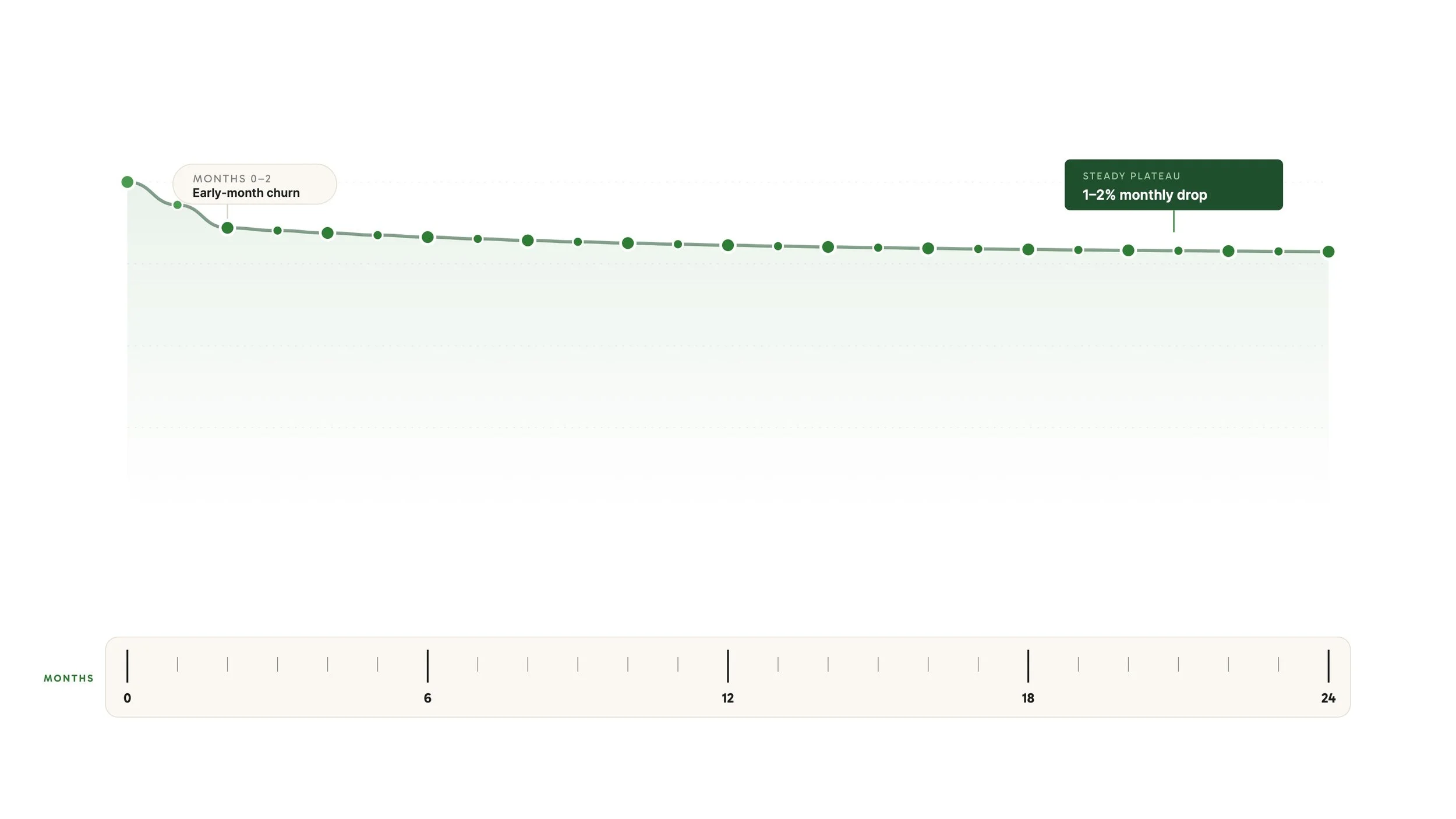
10% of new monthly donors stop within 2 months of setup
81% are still active after 7 months
71% are still active after 12 months
54% are still active after 24 months
After year one, nonprofits lose 1-2% of monthly donors per month
Compare those numbers to one-time donor retention. The Fundraising Effectiveness Project reports that only 19% of first-time donors return to give again in any given year, and overall retention across all online donors averaged 48% in 2024.
The retention gap is not a small advantage. It's the structural reason monthly giving programs grow.
Why monthly donors retain at higher rates
Three factors drive higher retention for monthly donors compared to one-time donors:
1. The default is to continue. A one-time donor has to actively decide to give again. A monthly donor has to actively decide to stop. The cognitive cost of action is on the cancellation side, not the continuation side.
2. The financial commitment per cycle is small. A donor giving $24 per month is making a smaller ongoing decision than a donor considering whether to write a $300 check today. The smaller per-cycle commitment is easier to maintain over time.
3. Monthly donors are pre-qualified. They've already crossed the "I support this organization" threshold. They aren't deciding whether to give. They're deciding whether to continue.
This combination is why subscription businesses (Netflix, Spotify, gym memberships) all default to recurring models. It's also why the nonprofit sector is increasingly treating monthly giving as the foundation of online fundraising rather than a side experiment.
The compounding math of monthly donor retention
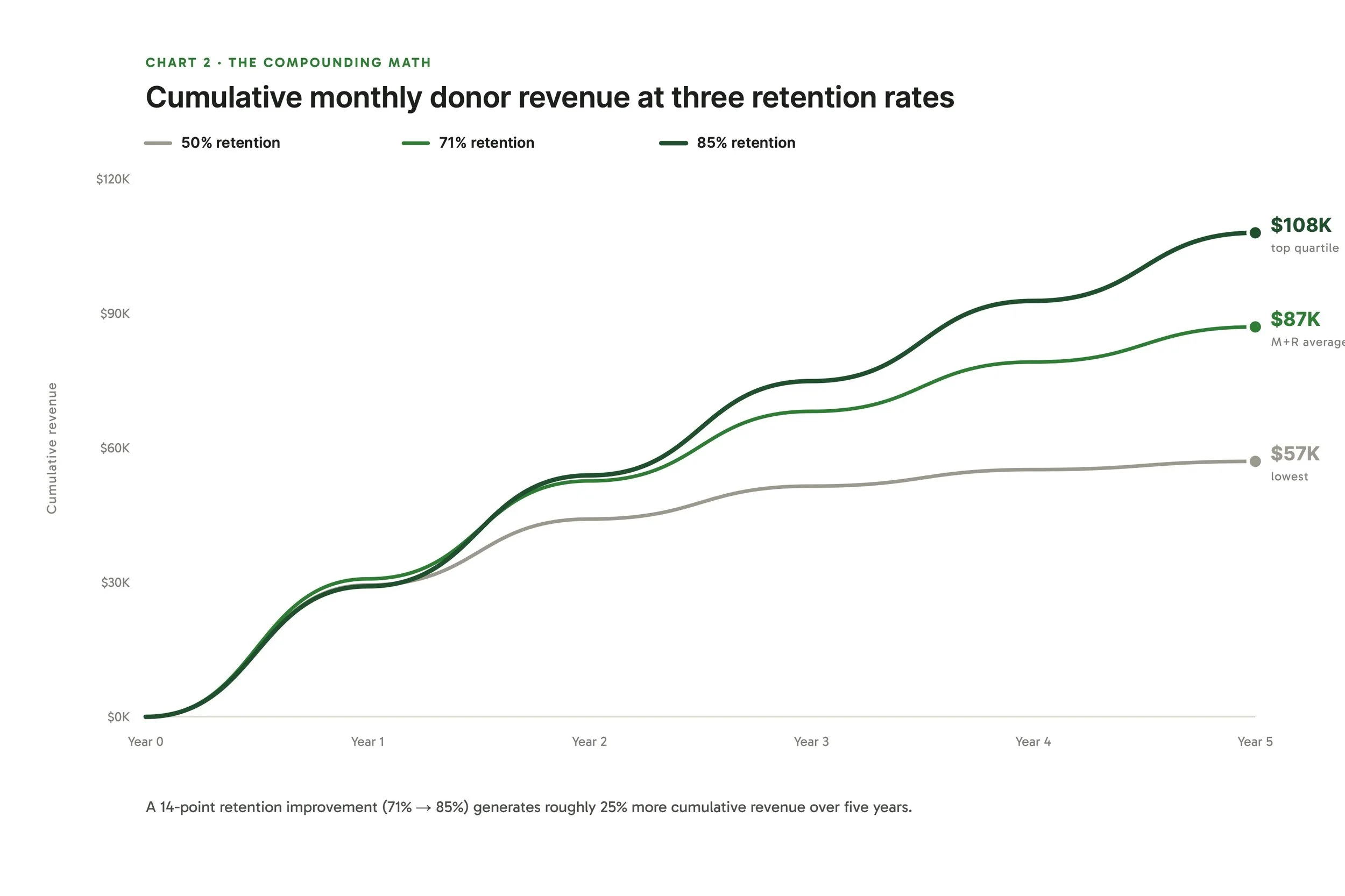
Retention math is what makes monthly giving so valuable. Consider three scenarios for a nonprofit acquiring 100 new monthly donors at $24/month each year:
Scenario 1: 50% annual retention
Year 1: ~$24,000 in retained donations
Year 2: ~$36,000 (50 retained donors plus 100 new)
Year 5: ~$57,000 in active monthly recurring revenue
Scenario 2: 71% annual retention (M+R average)
Year 1: ~$29,000
Year 2: ~$45,000
Year 5: ~$87,000
Scenario 3: 85% annual retention
Year 1: ~$31,000
Year 2: ~$50,000
Year 5: ~$108,000
A 14-point improvement in retention (from 71% to 85%) generates roughly 25% more cumulative revenue over five years. A 35-point improvement (from 50% to 85%) nearly doubles it.
This is the lever most nonprofits don't pull because retention work doesn't feel like fundraising. It feels like operations.
The hidden churn problem most nonprofits miss
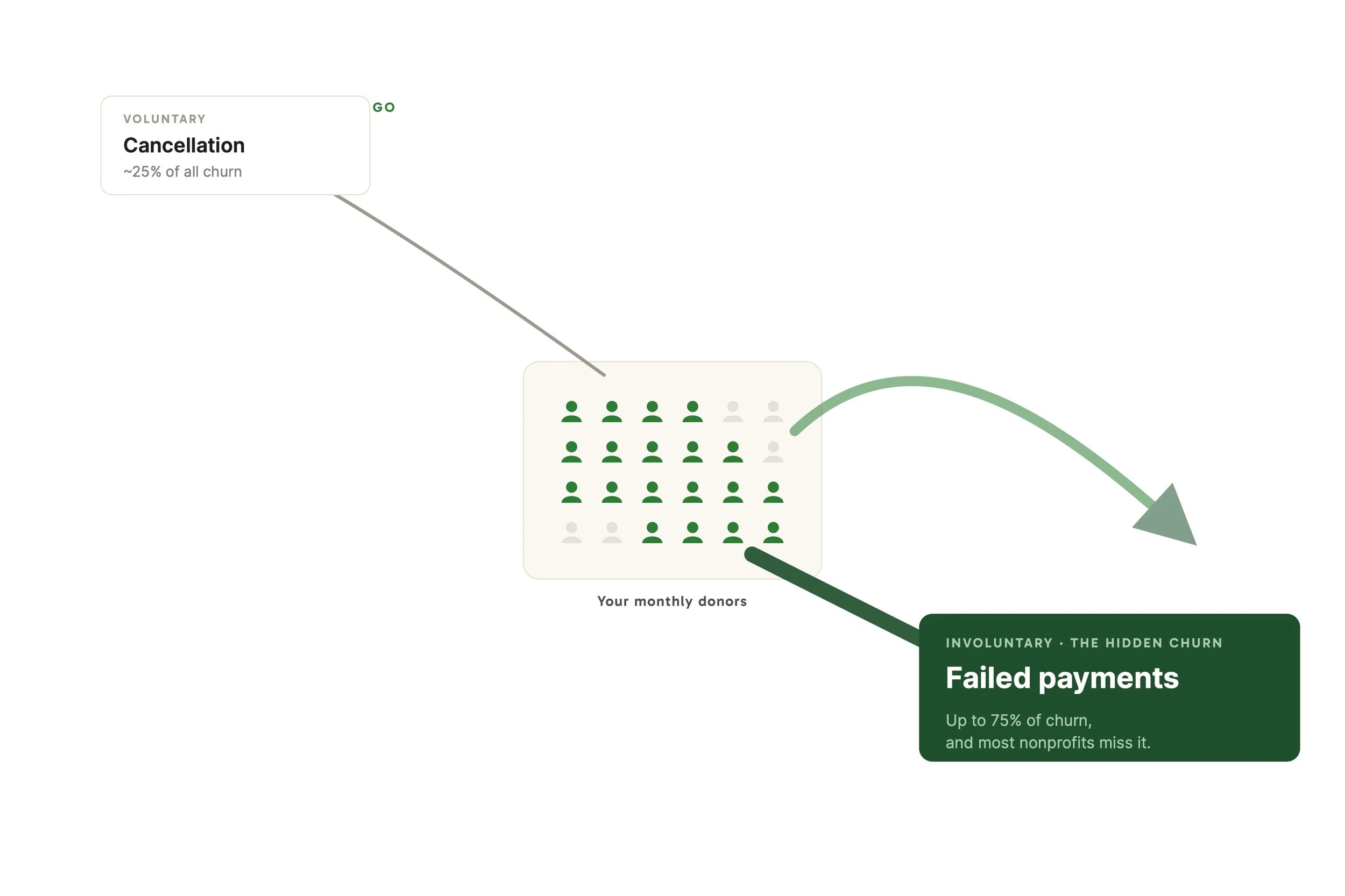
The biggest assumption that hurts monthly donor retention is that churn comes from donors actively deciding to cancel.
The data suggests otherwise.
Across payment processing platforms, a significant portion of recurring donation losses come from involuntary churn: failed payments. Expired cards. Insufficient funds. Fraud flags. Cards reported lost or stolen. Most donors who get caught in payment failures didn't choose to stop giving. Their payment method stopped working, and they were never recovered.
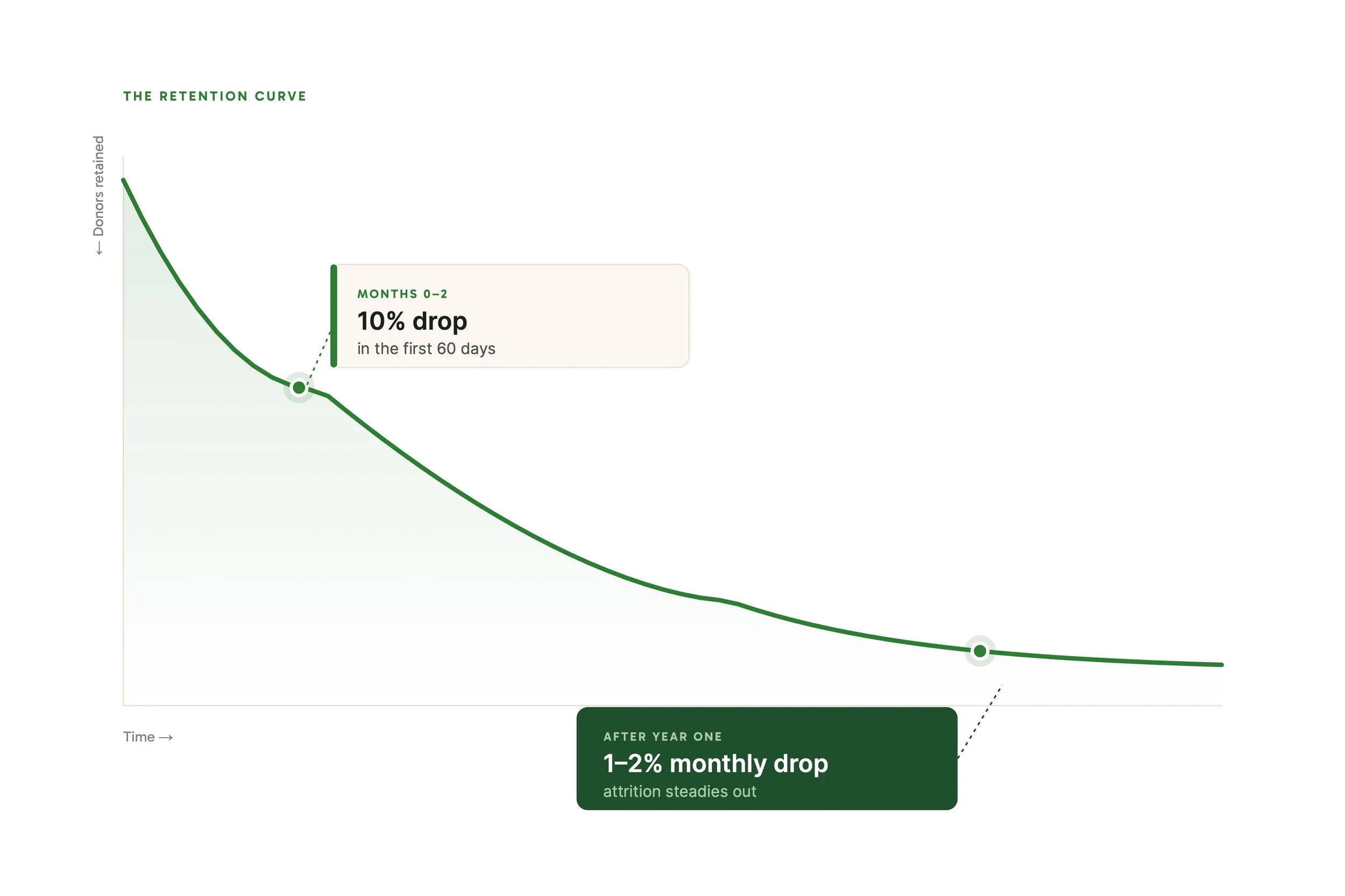
Two churn windows matter most:
The first 60 days. M+R Benchmarks 2026 reports that 10% of new monthly donors stop within 2 months of setup. This is the highest-churn window in the entire monthly donor lifecycle. Most of these are donors whose commitment never fully cemented (they set up the donation, then changed their mind). A welcome series, a confirmation of when the first charge will hit, and clear early communication reduce this drop substantially.
Ongoing card failures. After year one, the typical attrition pattern is 1-2% per month. A meaningful share is involuntary. Cards expire every 3-4 years on average. Reissuance happens after fraud events. Failed payments without automatic retry and donor outreach become permanent losses.
Two practical implications follow: build a real welcome series for new monthly donors, and treat failed payments as a recovery workflow rather than a billing technicality.
How to improve monthly donor retention
Five tactics, ordered by impact:
1. Onboard new monthly donors deliberately. Send a welcome email within minutes of signup, then 2-3 more in the first 30 days. Confirm the donation will process, explain when the first charge will hit the card, and share early impact stories. The goal is to lock in the decision before the 60-day churn window.
2. Build a card update workflow. When a payment fails, the platform should retry on a schedule and reach out to the donor with a simple way to update their payment method. Stripe handles automatic retries by default, but the donor outreach piece varies significantly by platform.
3. Communicate differently with monthly donors than with one-time donors. Most nonprofits send the same email cadence to both. That's a missed opportunity. Monthly donors deserve to hear about impact, not just appeals. Cut the monthly donor segment out of solicitation emails where possible and replace those touches with thank-you and impact updates.
4. Make annual appreciation tangible. A handwritten note. A small gift. An exclusive monthly donor update with photos from the field. Something that signals these donors are different and important. The cost is small relative to the lifetime value of a retained sustainer.
5. Track monthly donor cohort retention. Most nonprofits don't know what their actual retention curve looks like. Pulling a quarterly cohort report (how many donors who signed up in Q1 are still giving in Q2, Q3, Q4) surfaces problems early. Without the report, churn is invisible until it shows up as a missing line item on the year-end report.
Frequently asked questions
What is a good monthly donor retention rate?
A healthy benchmark for monthly donor retention is 70-75% at 12 months, in line with the M+R Benchmarks 2026 average of 71%. Organizations above 80% at 12 months are performing in the top tier. Organizations below 60% at 12 months should investigate whether failed payments and weak onboarding are driving avoidable churn.
How long does the average monthly donor stay enrolled?
About half of monthly donors are still giving after two full years, according to M+R Benchmarks 2026. After the first year, attrition averages 1-2% per month. The longest-tenured monthly donors often give for 5 or more years, making the lifetime value of a long-retained sustainer many multiples of any single one-time gift.
Why do monthly donors cancel?
Donors cancel for many reasons including financial changes, shifting priorities, and dissatisfaction with the organization. But a meaningful share of recurring giving losses are involuntary: failed payments from expired cards, insufficient funds, or fraud flags. Most nonprofits don't have visibility into the difference between voluntary cancellation and involuntary churn.
What percentage of nonprofit online revenue comes from monthly donors?
Across all nonprofits in the M+R Benchmarks 2026 study, monthly giving accounts for 27% of total online revenue. The share scales with organization size: 22% for nonprofits under $1M in annual online revenue, and 37% for nonprofits over $10M. Public Media nonprofits, who often default donation pages to monthly, pull 61% of online revenue from recurring donors.
Is monthly donor retention the same as overall donor retention?
No. Overall donor retention typically measures whether a donor gave again in a subsequent period. Monthly donor retention measures whether the recurring transaction is still active month over month. The two metrics behave very differently, with monthly donor retention curves looking much more like SaaS subscription retention than traditional donor retention curves.
How can a nonprofit reduce monthly donor churn?
The two highest-impact tactics are (1) building a deliberate welcome series for new monthly donors to lock in the decision in the first 60 days, and (2) treating failed payments as a recovery workflow rather than a billing technicality. Most donors caught by failed payments didn't choose to stop giving. Their card just stopped working.
A platform built for the long game
Monthly donor retention is won at the operational layer, not the campaign layer. The platforms that make retention easier are the ones with the monthly toggle built directly into the donor flow, fast-loading donation pages, branded donor experiences (no third-party redirects), and automatic payment retries via Stripe.
FundEasy is built around these fundamentals. Every account gets a hosted giving page with monthly donations built into the donor flow. Donations process automatically through Stripe, which handles card retries on failed payments. Recurring and one-time gifts show up in a single transactions view, making cohort tracking straightforward.
If your organization is evaluating how to build or improve a monthly giving program, starting with a platform that has the operational basics right makes everything else easier.