Recurring Giving for Non-Profits: What It Is and How to Start
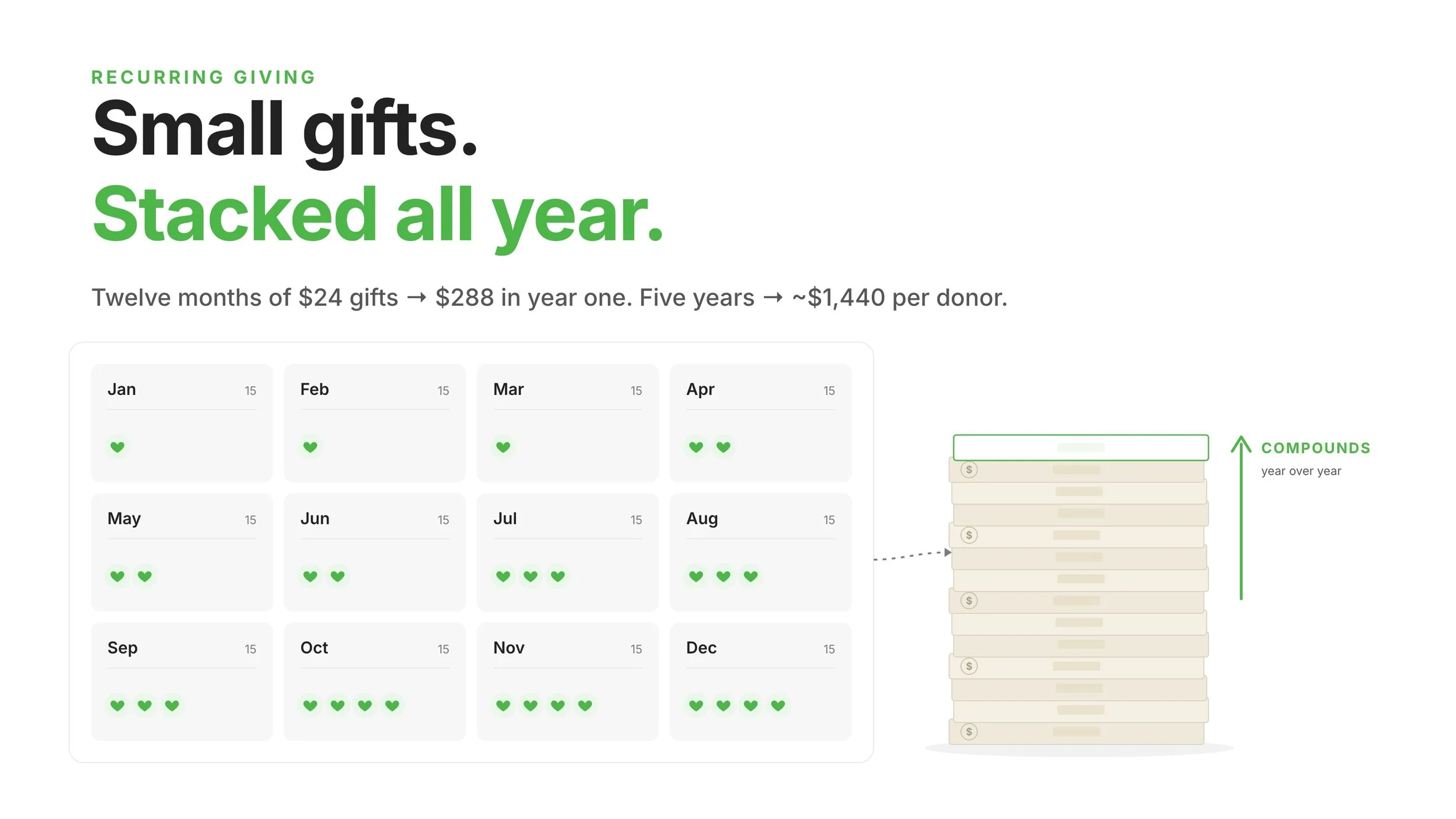
Recurring giving is a fundraising approach where donors commit to automated, repeating donations to a nonprofit, most often on a monthly basis. Also called monthly giving, sustainer giving, or recurring donations, the model lets a donor set up a smaller amount that processes automatically through the nonprofit's payment system instead of giving one larger gift once a year. For nonprofits, recurring giving creates predictable monthly revenue and far higher donor lifetime value than one-time fundraising alone.
Most nonprofits raise the majority of their annual revenue from a handful of events and seasonal appeals. The gala. The walk-a-thon. The year-end push. Those campaigns work, but the calendar resets every January, and the fundraising team has to start the engine from scratch.
A recurring giving program creates a different kind of revenue. The kind that shows up every month, whether or not a campaign is running. For nonprofits with even small recurring giving programs, monthly donors often fund a meaningful portion of operating costs and grow steadily year over year.
How recurring giving works
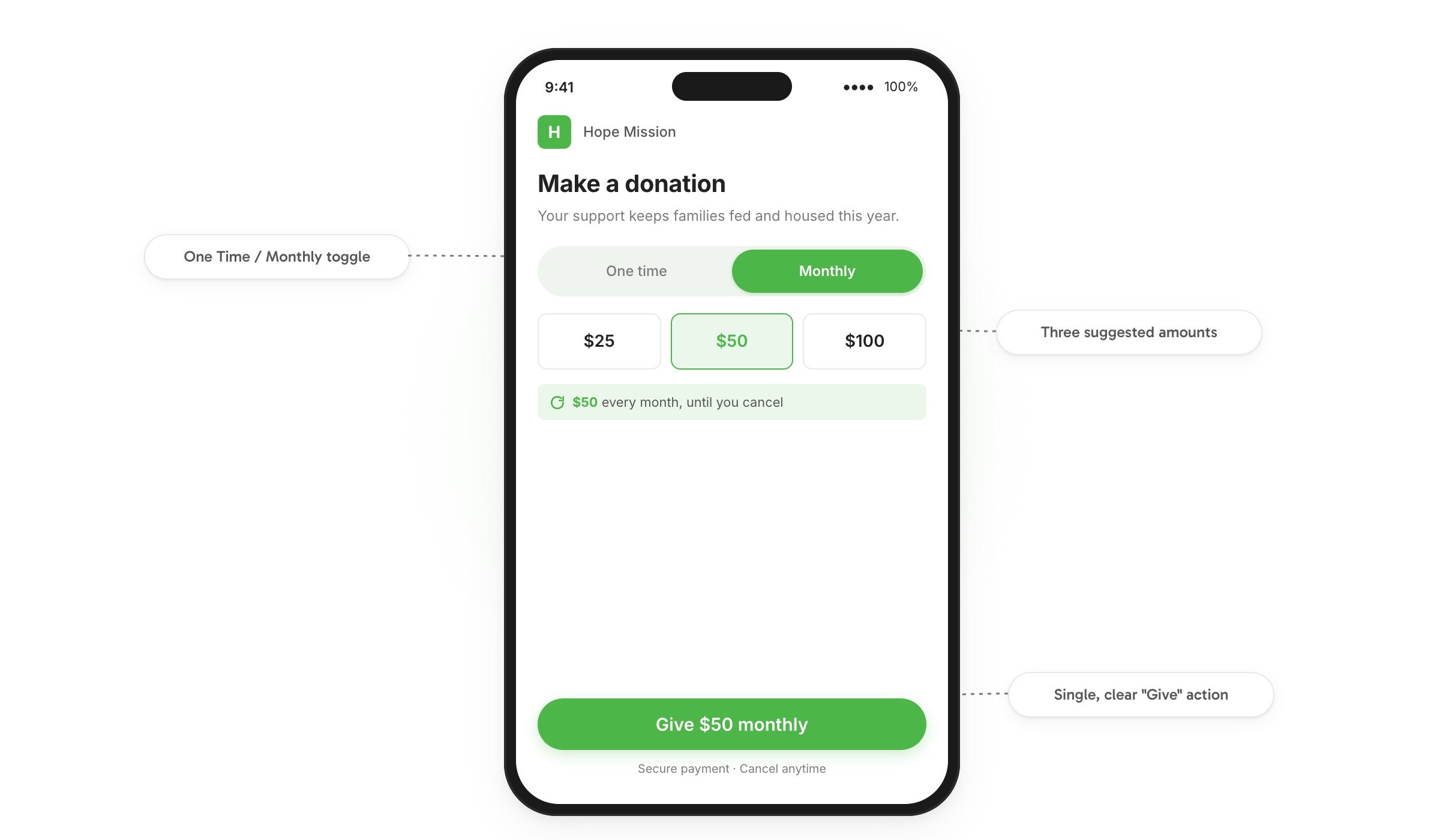
The donor experience is straightforward. A donor visits the nonprofit's donation page, chooses an amount, and selects "monthly" instead of "one-time." Their payment method gets stored securely with a payment processor like Stripe, and the same amount is processed on the same day each month. The donor receives an email receipt every time.
Modern fundraising platforms handle the technical side automatically. Failed payments get retried. Receipts go out. Donations show up in the same dashboard as one-time gifts. No manual work is required after setup.
If a donor wants to cancel or change their donation, the workflow varies by platform. On most platforms, including FundEasy today, donors contact the nonprofit, and the nonprofit adjusts the donation through the payment processor. Some platforms (Tithe.ly, Bloomerang Fundraising, Donorbox) offer donor self-service portals where donors can update or cancel their own recurring gifts. Donor self-service is increasingly common, but not yet universal.
Why recurring giving matters for nonprofit revenue
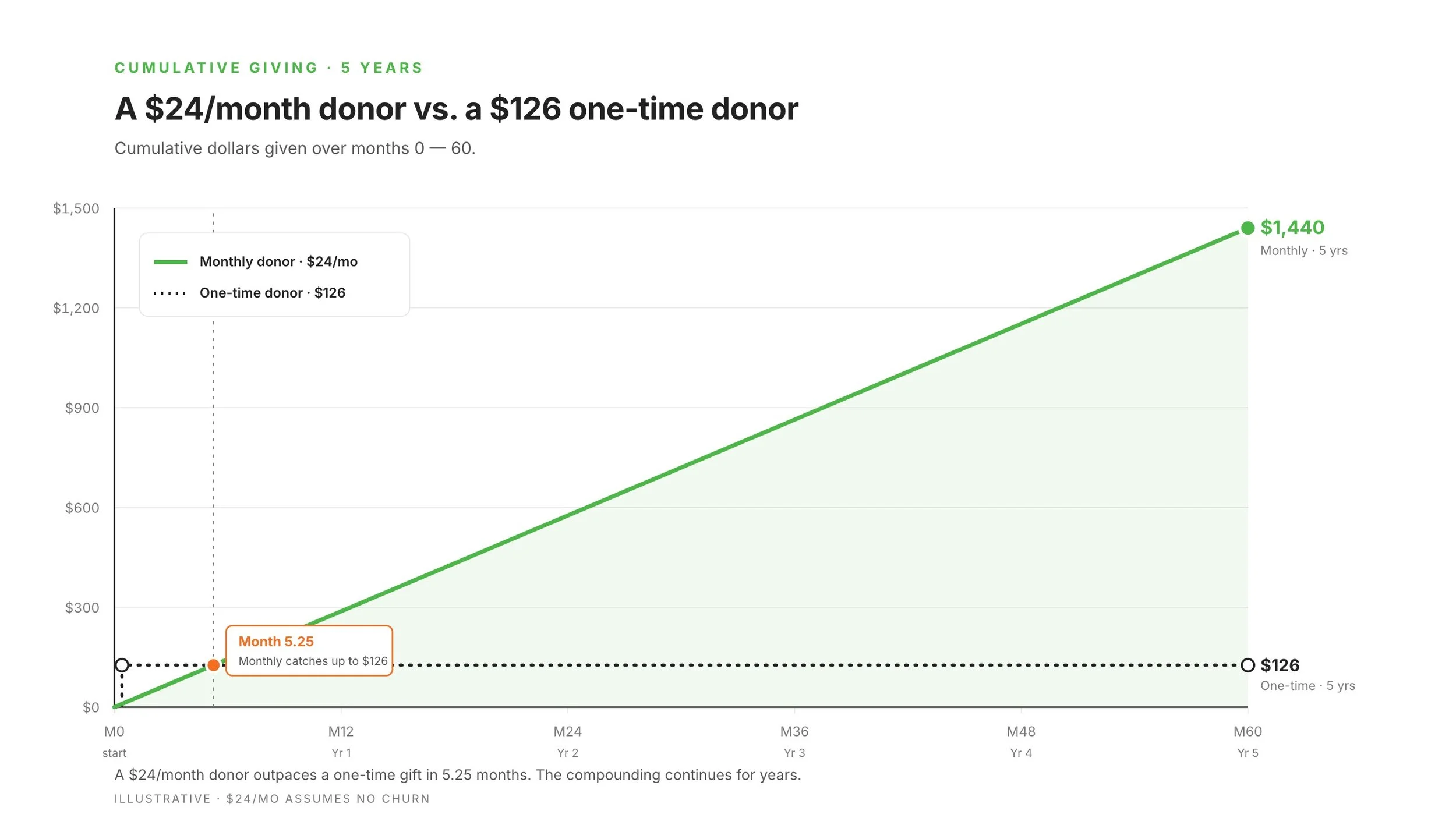
The math is what makes recurring giving so valuable. Consider two donors based on the M+R Benchmarks 2026 averages:
Donor A gives $126 once, in December (the average one-time online gift).
Donor B gives $24 a month starting in January (the average monthly gift).
In month 5.25, Donor B has matched Donor A's one-time gift. By the end of year one, Donor B has contributed $288 and is statistically likely to still be giving. M+R Benchmarks 2026 reports that 71% of monthly donors are still active after 12 months and 54% are still active after 24 months. Meanwhile, retention for new online donors sits at roughly 24%, per the Fundraising Effectiveness Project.
This is the compounding effect that makes monthly giving programs grow faster than one-time fundraising. Across all nonprofits in the M+R study, monthly giving accounts for 27% of total online revenue. For larger nonprofits (over $10M in annual online revenue), that share climbs to 37%. Public Media nonprofits, who default donation pages to monthly, pull 61% of online revenue from recurring donors.
Recurring giving vs. one-time donations
One-time donations are easier to acquire but harder to retain. Recurring donations are slightly harder to acquire but much easier to retain and grow.
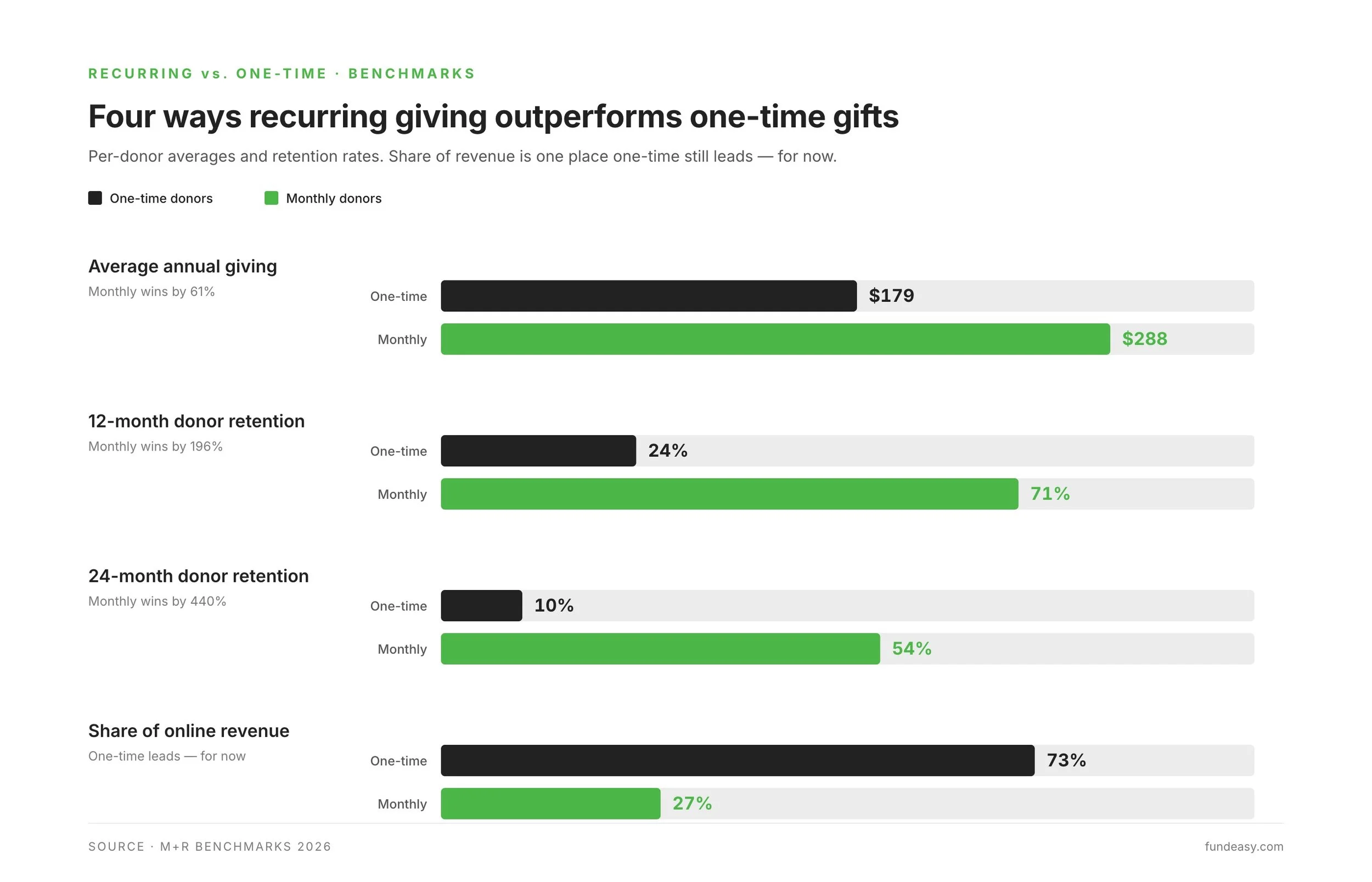
| Metric | One-time donors | Monthly donors |
|---|---|---|
| Average gift size | $126 per gift | $24 per month |
| Average annual giving | $179 (1.3 gifts/year) | $288+ (when retained) |
| 12-month retention | ~24% (new donors) | 71% |
| 24-month retention | ~10% | 54% |
| Time to outpace one-time gift | N/A | 5.25 months |
| Share of online revenue | 73% (and shrinking) | 27% (and growing) |
The strongest nonprofit fundraising programs use both. One-time donations from events and seasonal campaigns acquire new donors. The monthly giving program retains those donors and grows the floor underneath everything else.
What you need to start a recurring giving program
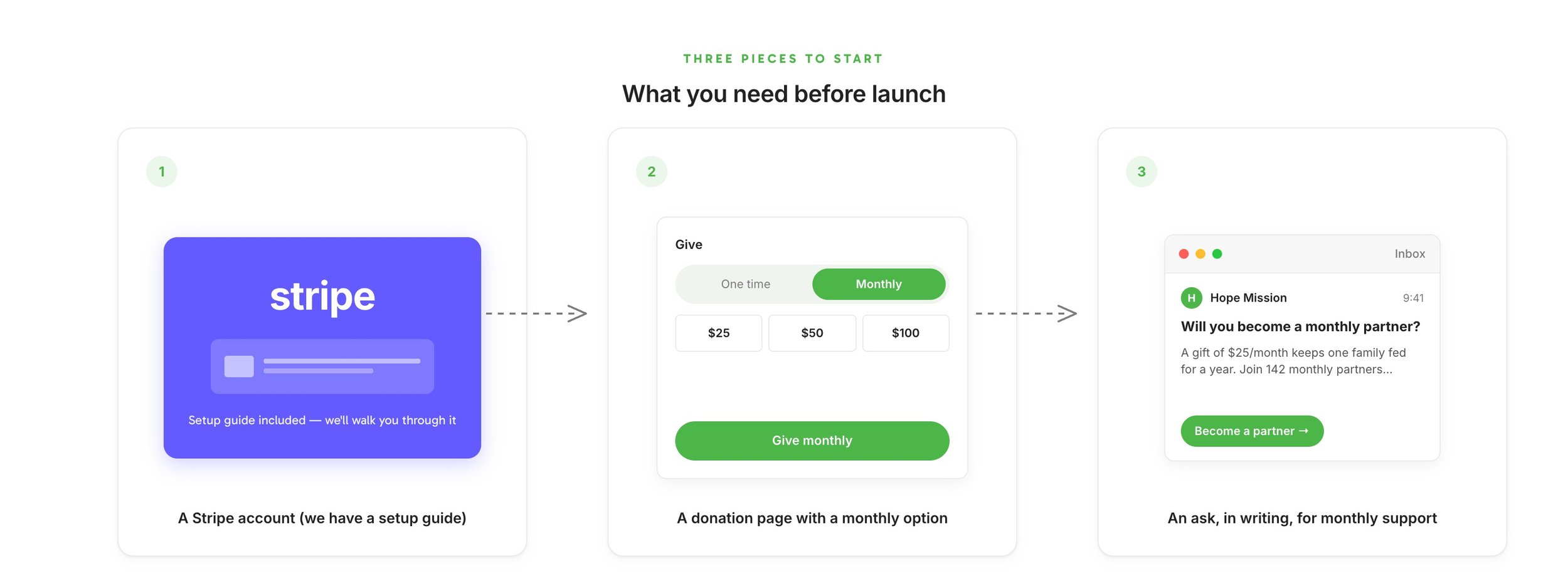
Three things, in order:
A payment processor that supports recurring billing. Most nonprofits use Stripe. Setup takes about five minutes if your org has the EIN, bank account details, and authorized signer information ready.
A donation page with a monthly toggle built into the flow. The monthly option needs to sit one tap away from the one-time option. Forcing donors into a separate form for recurring gifts is one of the fastest ways to drop completion rates.
A communication plan to ask for monthly gifts specifically. Most donors will not become monthly donors by default. They need to be asked, with framing that emphasizes the ongoing impact of a smaller monthly amount.
That's it. No CRM integration, no leaderboard, no advanced automation required. Those things help later but are not required to start.
Platforms built around this approach, including FundEasy, ship with a hosted giving page that already has the monthly toggle in the donor flow. Connect Stripe and the page is ready to share.
Common mistakes nonprofits make with recurring giving
The single most common mistake is treating the recurring giving launch as a one-time announcement instead of an infrastructure change.
Most organizations send a "we now have recurring giving!" email to their full list. That works for the first wave. It does not produce sustained growth. The bigger lever is making sure every existing donation entry point already has the monthly toggle visible and the ask written into the donation form.
Most nonprofits already have traffic coming in from event pages, social media, and email links. The monthly toggle should be there to catch donors in the moment they decide to give.
Other common mistakes:
Not following up with donors who increase or decrease their monthly amount
Treating monthly donors the same as one-time donors in email communications
Failing to thank monthly donors annually with something tangible
Using a donation flow that requires donors to create an account, which drops completion rates sharply
Frequently asked questions
What is the difference between recurring giving and a one-time donation?
A one-time donation is a single transaction completed in a single moment. A recurring donation is an automated, repeating transaction, most often charged monthly, that continues until the donor cancels
How much should a nonprofit ask for as a monthly recurring donation?
Most nonprofits suggest amounts between $10 and $50 per month. $25 is the most common recurring gift size in the United States, according to M+R Benchmarks. The right amount depends on the nonprofit's average donor income and existing donation history.
Do recurring donors give more than one-time donors?
Yes, by a wide margin. A $24 monthly donor (the M+R Benchmarks 2026 average) outpaces a $126 one-time gift in 5.25 months and continues compounding from there. Monthly donors also make an average of 0.2 additional one-time gifts per year worth around $21 each. Combined with retention rates of 71% at 12 months and 54% at 24 months, monthly donors deliver multiple times the lifetime value of one-time donors over any meaningful timeframe.
Is recurring giving the same as monthly giving?
Mostly yes, in practice. Recurring giving technically covers any automated, repeating donation (weekly, monthly, quarterly, or annually). Monthly giving is by far the most common form, accounting for the overwhelming majority of recurring gifts in the U.S. nonprofit sector. Most platforms use the terms interchangeably, and most donors think in monthly terms.
How do donors cancel a recurring donation?
It varies by platform. On most platforms, donors contact the nonprofit, which adjusts the donation through the payment processor. Some platforms like Tithe.ly, Bloomerang Fundraising, and Donorbox offer donor self-service portals where donors can update or cancel their own recurring gifts. Donor self-service is increasingly common but not yet universal.
What percentage of donors typically become recurring donors?
The percentage varies dramatically by how the donation page is designed. M+R Benchmarks 2026 found that 64% of nonprofits default their donation pages to one-time gifts, and most see monthly opt-in rates in the single to low double digits. Public Media nonprofits, which often default the donation page to monthly, see 86% of donors choose the monthly option and pull 61% of total online revenue from recurring donors. The pattern is clear: when monthly is the default or visually equal to one-time, opt-in rates climb significantly.
What is the best platform for nonprofit recurring giving?
The best platform depends on what else the nonprofit needs. Organizations that run events alongside online giving benefit from a unified platform like FundEasy, which handles event registration, recurring giving, crowdfunding, and reporting in one place. Churches focused on tithing often use Tithe.ly. Organizations that need full donor management (CRM) plus fundraising tend toward Bloomerang Fundraising (formerly Qgiv) or Neon One. Smaller orgs focused on standalone donation pages often use Donorbox or Givebutter.
A faster path to launching recurring giving
The nonprofits that grow their recurring giving programs fastest do not treat the launch as a big announcement. They treat it as an infrastructure change.
The real work is making sure every donation entry point has the monthly toggle visible in the same flow. The website donation button. Every event page. Every email link. The announcement email produces a one-time spike. The infrastructure change is what compounds over the following year.
FundEasy is built with this approach in mind. Every account gets a hosted giving page the moment Stripe is connected, with the monthly toggle in the donor flow by default. Organizations can create multiple giving pages for different campaigns, and every page treats recurring giving as a first-class option, not an afterthought.
If your nonprofit is evaluating how to add recurring giving to your fundraising program, starting with a platform that has it built in saves months of setup work.