Recurring Giving vs. Peer-to-Peer: Which Does Your Nonprofit Need?
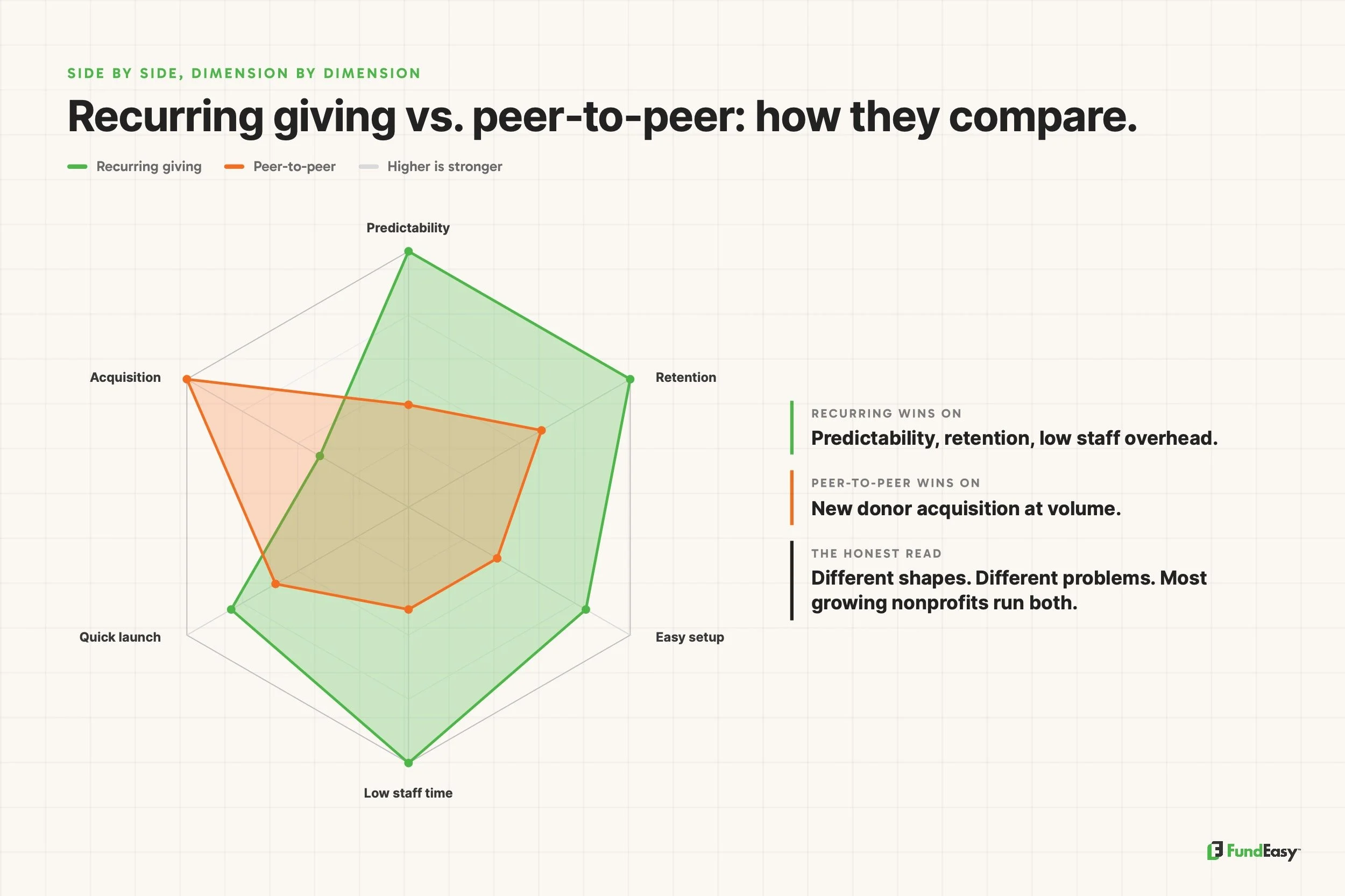
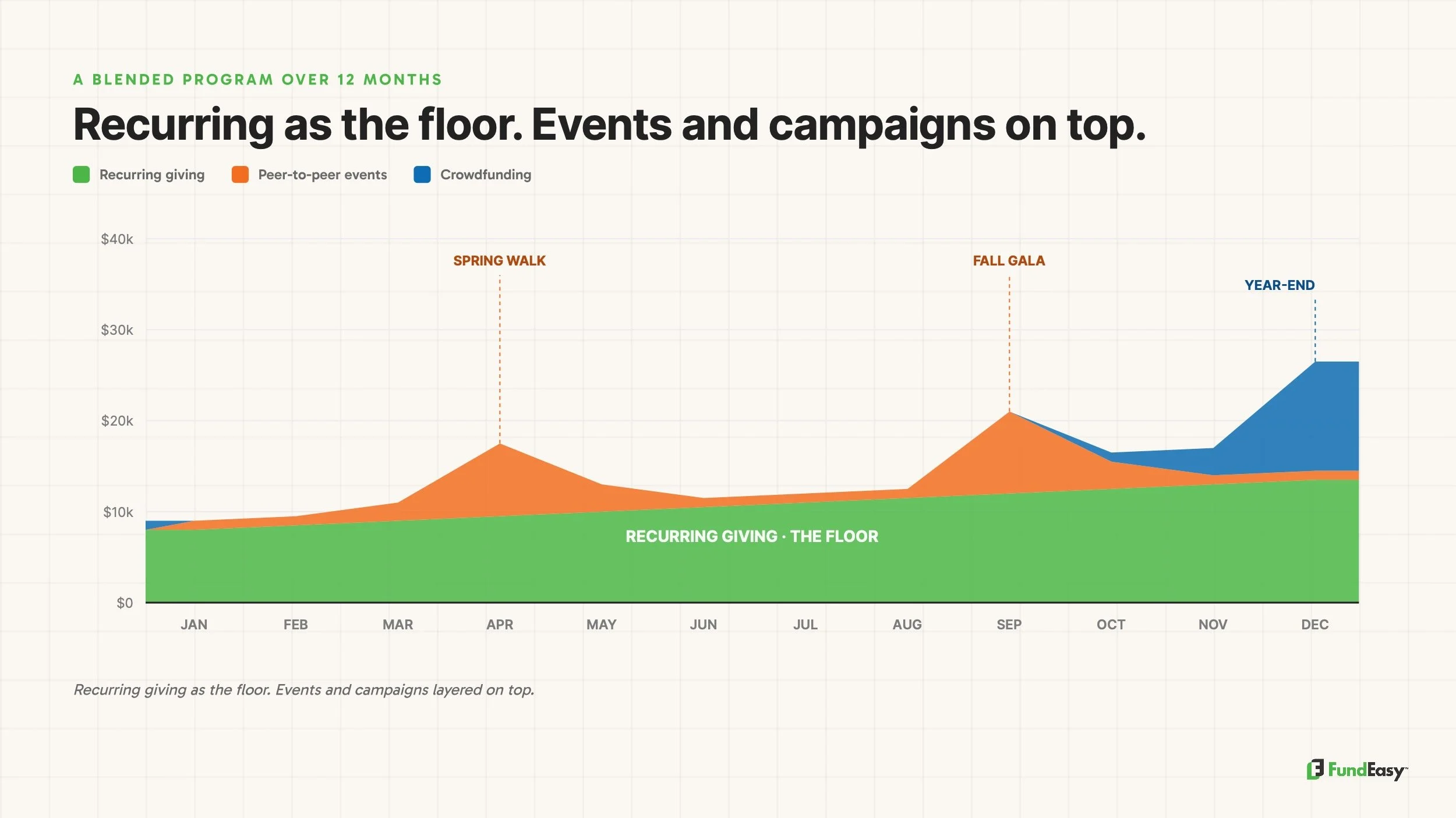
Recurring giving and peer-to-peer fundraising solve fundamentally different problems for nonprofits. Recurring giving builds predictable, ongoing monthly revenue from a base of committed supporters. Peer-to-peer fundraising acquires new donors at scale through events and supporter-driven campaigns. Most growing nonprofits use both, with recurring giving as the always-on revenue floor and peer-to-peer as the donor acquisition engine that feeds into it.
For nonprofits evaluating where to invest fundraising time and platform budget, the right choice depends on which problem is more urgent: keeping the lights on with predictable revenue, or expanding the donor base through new acquisition channels.
This guide compares both methods, who each works best for, and how the two work together when run alongside each other.
What is recurring giving?
Recurring giving is a fundraising method where donors commit to automated, repeating donations to a nonprofit, most often on a monthly basis. The donor sets up a smaller amount that processes automatically through the nonprofit's payment system instead of giving one larger gift once a year.
For nonprofits, recurring giving creates predictable monthly revenue. Across all nonprofits, monthly giving now accounts for 27% of total online revenue, according to M+R Benchmarks 2026. For nonprofits over $10M in annual online revenue, that share climbs to 37%.
For a deeper look at recurring giving specifically, the pillar guide covers what it is, why it matters, and how to get started.
What is peer-to-peer fundraising?
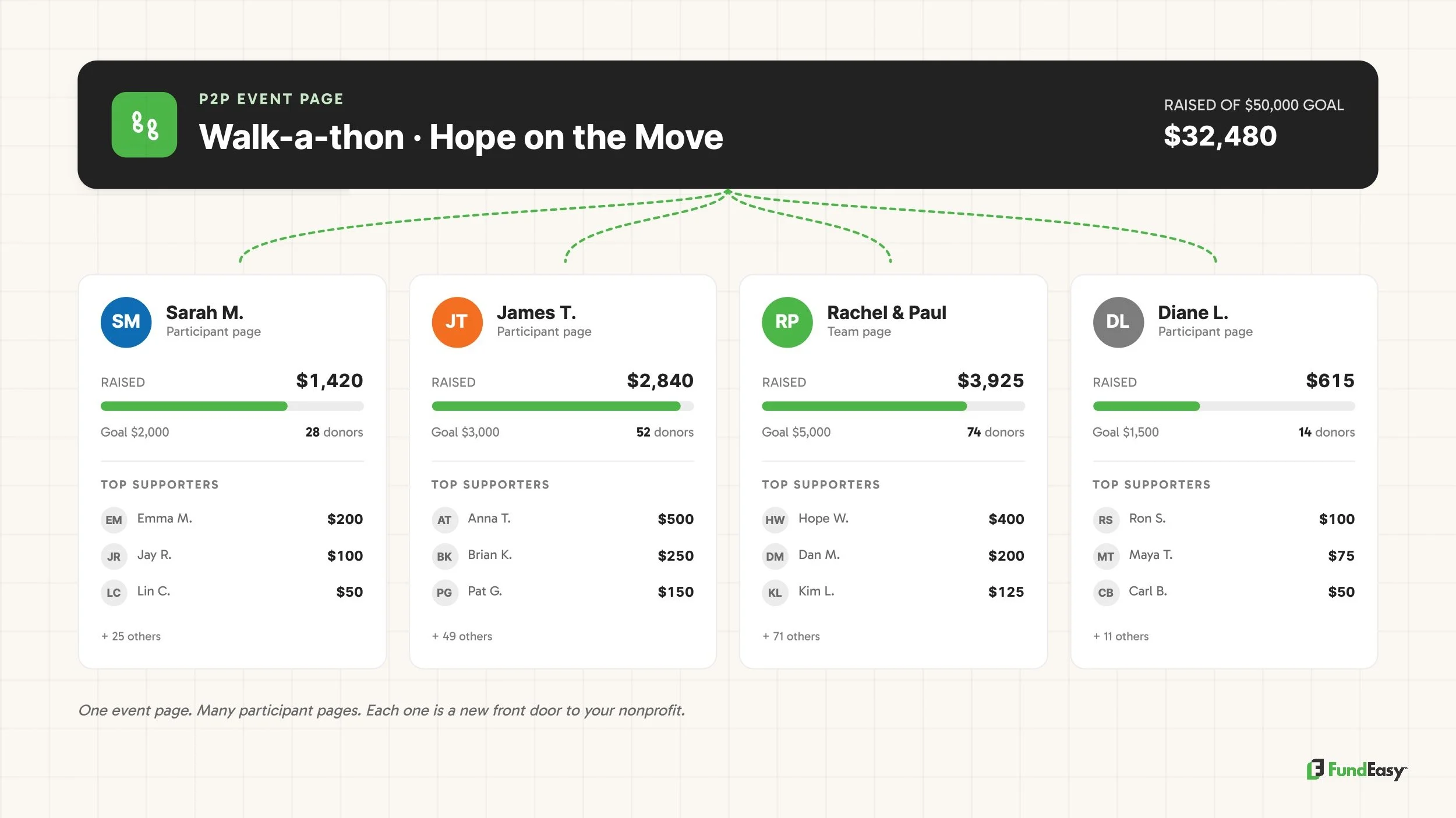
Peer-to-peer fundraising (often called P2P) is a method where supporters of a nonprofit raise money on its behalf through personal fundraising pages. A walk-a-thon, a birthday fundraiser, a marathon training campaign — all classic peer-to-peer use cases. Each participant creates a personal page, shares it with their network, and collects donations from friends, family, and colleagues.
Peer-to-peer fundraising spreads through social networks, not the nonprofit's email list. That's both its biggest strength and its key constraint. Done well, P2P brings in donors the nonprofit could never reach through its own channels. Done poorly, it produces lots of one-off small gifts from donors who never become regular supporters.
The most common P2P formats:
Event-based P2P. Tied to a specific event (walk, run, ride). Participants register for the event and create a fundraising page as part of registration. Most P2P revenue still flows through event-based campaigns.
Independent P2P campaigns. Standalone fundraisers tied to a cause (a memorial fund, a birthday fundraiser, an emergency response). Not tied to an event.
Team or team-based P2P. Participants organized into teams, with combined fundraising goals and leaderboards.
Recurring giving vs. P2P: key differences
The two methods serve different roles in a nonprofit's fundraising program
| Factor | Recurring giving | Peer-to-peer |
|---|---|---|
| Primary outcome | Predictable, ongoing monthly revenue | New donor acquisition at scale |
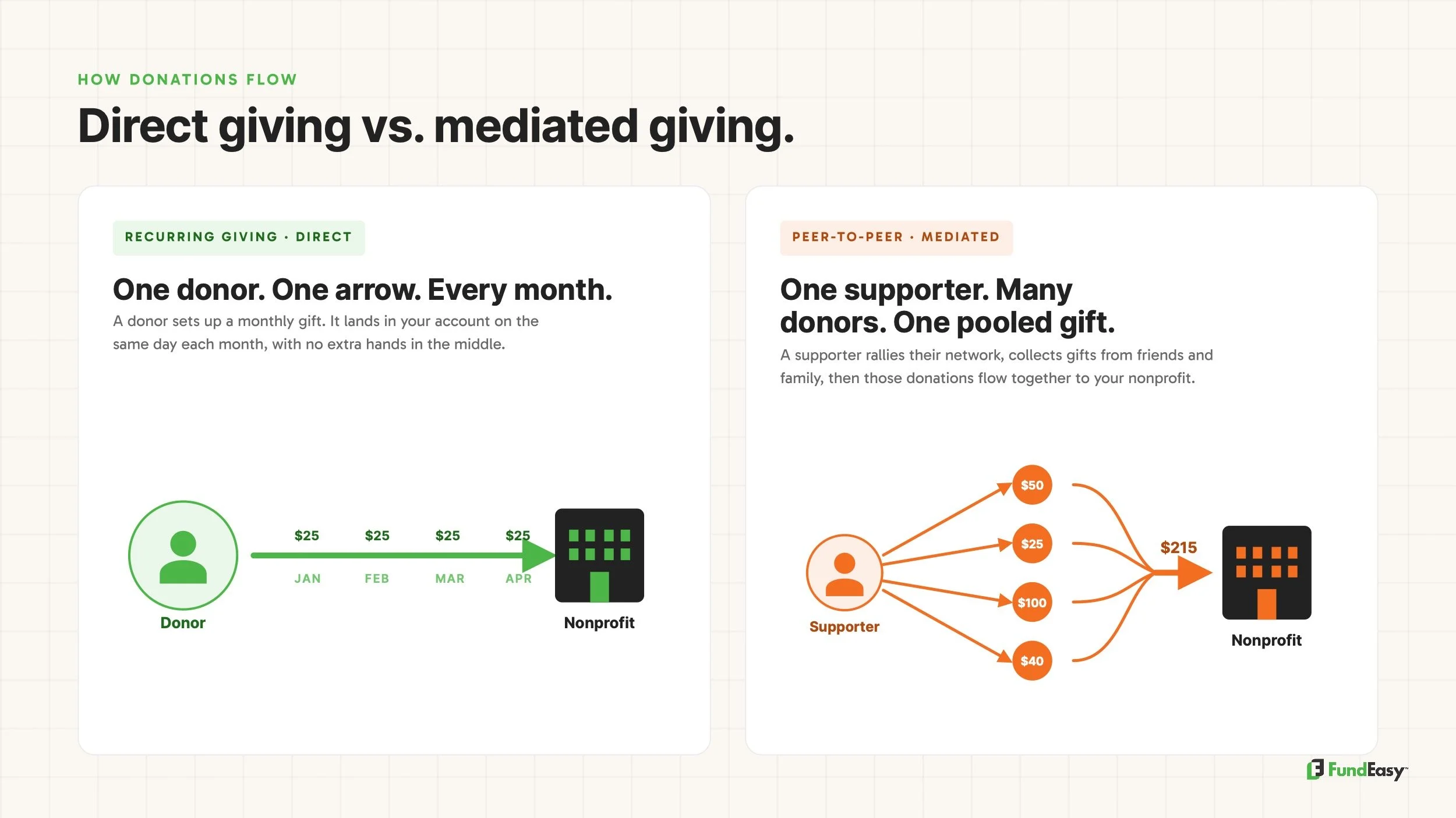
| Donor relationship | Direct: nonprofit-to-donor | Mediated: through existing supporters |
| Setup complexity | Low (page can be live in 30 minutes) | Higher (requires participant recruitment, training, event logistics) |
| Time to revenue | Same day | Weeks to months |
| Revenue predictability | High (monthly cadence) | Low (campaign-driven spikes) |
| Donor lifetime value | High (71% retain at 12 months) | Lower (one-off gifts unless converted) |
| Staff time investment | Low ongoing | High during campaign periods |
| Best for | Sustainable revenue floor | Awareness, acquisition, community |
The right way to read this table: recurring giving is the steadier, easier-to-maintain method. Peer-to-peer is the harder, higher-reach method. Neither is universally better. They solve different problems.
When recurring giving is the right choice
Recurring giving is the better starting point if any of these apply:
The nonprofit has a small team and can't invest in heavy campaign management
Existing donors are loyal but episodic (give once a year, then go quiet)
Operating revenue is unpredictable and quarterly cash flow is a recurring stress
The organization has an existing email list and supporter base to ask
The mission is ongoing rather than tied to specific moments or events
In practice, almost every nonprofit benefits from at least a basic recurring giving program. The lift to set one up is low, the revenue is predictable, and the lifetime value math works in favor of the nonprofit. Many fundraising consultants now recommend recurring giving as the first online fundraising channel a nonprofit builds.
When peer-to-peer is the right choice
Peer-to-peer is the better fit when any of these apply:
The nonprofit hosts an annual signature event (walk-a-thon, gala, run/ride) that already gets significant participation
New donor acquisition is the bigger bottleneck than donor retention
The mission is tied to a specific time-bound moment (cancer awareness month, disaster response)
There's an active community of supporters willing to fundraise on the nonprofit's behalf
The nonprofit has the staff capacity to support participants through a campaign cycle
P2P requires more upfront work than recurring giving — recruiting participants, training them on how to fundraise, providing campaign materials, supporting them through the campaign period. The payoff is reach into networks the nonprofit doesn't directly own.
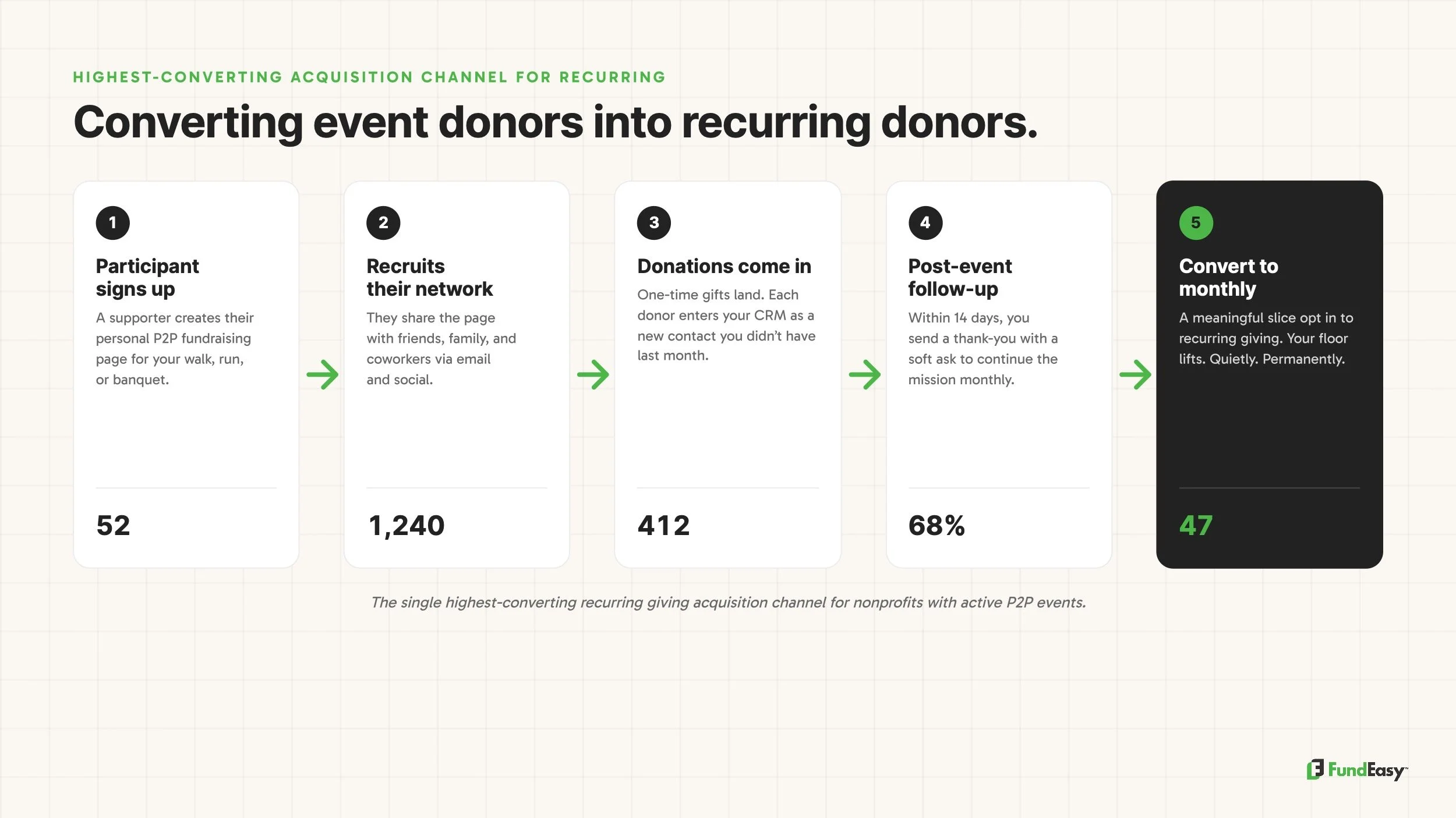
The strongest P2P programs convert event participants into ongoing donors after the event. That's where P2P and recurring giving connect: P2P brings in the donors; recurring giving keeps them.
Can you do both?
Yes, and most growing nonprofits should. The two methods work best as complementary parts of a single fundraising program rather than competing investments.
A common pattern that works well:
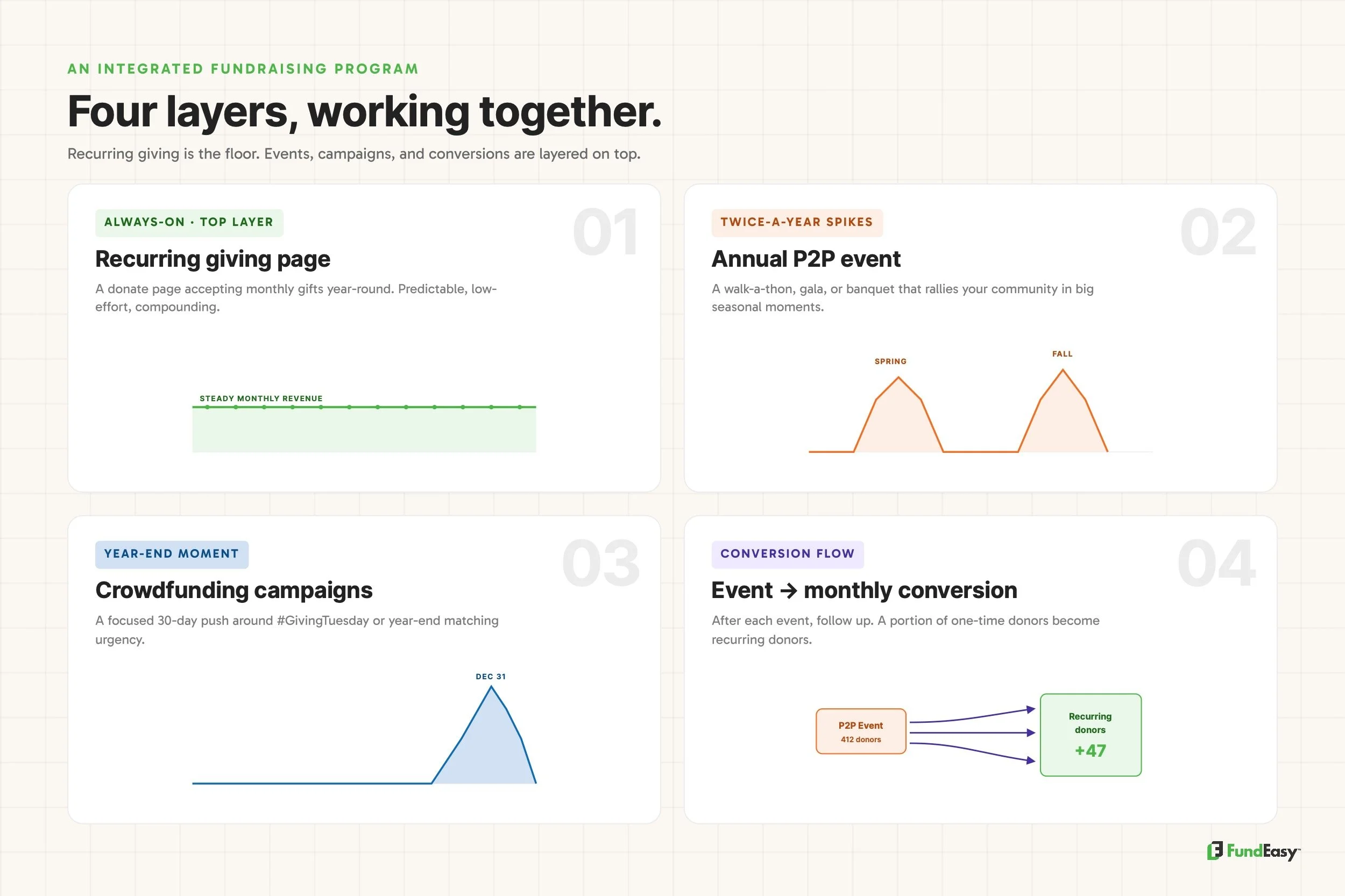
A recurring giving page lives on the nonprofit's website year-round. Always-on, capturing donors who arrive ready to give monthly.
A peer-to-peer event runs once or twice a year as the major acquisition push. Walk-a-thon, gala, ride, or run.
Event participants are converted to monthly donors after the event. Follow-up emails ask event donors to "continue the impact" with a monthly gift.
Crowdfunding campaigns fill in time-bound moments (Giving Tuesday, year-end, emergency appeals) that don't fit naturally into either recurring or P2P.
The platforms that handle both methods well are the ones where event registration, recurring giving, and donor data live in the same system. Stitching together separate platforms for events, P2P, and recurring giving usually means donor data gets fragmented and the conversion from event donor to monthly donor falls through the cracks.
Where FundEasy fits
FundEasy is built around the assumption that nonprofits need both methods. The platform handles event registration, ticketing, sponsorships, recurring giving, and crowdfunding in the same account, with all donations flowing into a single transactions view.
For nonprofits getting started with peer-to-peer, FundEasy currently supports event-based P2P, with personal fundraising pages tied to event registration. Standalone P2P use cases (birthday fundraisers, memorial campaigns, evergreen team fundraising) are not yet in scope; they're on the product roadmap for later release.
For recurring giving, every account ships with a hosted giving page that has the monthly toggle built into the donor flow. No setup beyond connecting Stripe.
If your nonprofit is evaluating how to combine both methods, the demo walks through the typical event + recurring giving setup and answers questions specific to your situation.
Frequently asked questions
What is the difference between recurring giving and peer-to-peer fundraising?
Recurring giving is direct nonprofit-to-donor: a donor sets up a monthly donation through the nonprofit's donation page, and the gift processes automatically. Peer-to-peer fundraising is mediated through existing supporters: a participant creates a personal fundraising page and collects donations from their own network on the nonprofit's behalf. Recurring giving produces predictable monthly revenue. P2P produces campaign-driven donor acquisition.
Which is more profitable for nonprofits?
Recurring giving typically produces higher donor lifetime value per donor, since recurring donors retain at 71% at 12 months versus the 24% retention for one-time donors (M+R Benchmarks 2026). P2P typically produces higher total acquisition volume in a short window, since each participant brings in donors the nonprofit wouldn't otherwise reach. The most profitable approach uses P2P for acquisition and recurring giving for retention.
Do I need separate platforms for recurring giving and peer-to-peer?
Not necessarily. Some platforms handle both in one account (including FundEasy, Bloomerang Fundraising, and Classy). Others specialize in one or the other. Running both on the same platform keeps donor data unified and makes it easier to convert P2P event donors into recurring donors after the event.
What's the easiest fundraising method to start with?
Recurring giving has the lowest setup overhead. A hosted giving page can be live the same day with most platforms, and the ongoing maintenance is minimal once the page is set up. Peer-to-peer requires more upfront planning, participant recruitment, and active campaign management during the run period.
Can peer-to-peer participants also become recurring donors?
Yes, and this is one of the biggest opportunities most nonprofits miss. P2P events bring in donors who give once. Following up with those donors after the event with a monthly giving ask is one of the highest-converting recurring giving acquisition channels available. The conversion only works if the same platform tracks both event donations and recurring donations.
Is peer-to-peer fundraising still effective?
Yes, particularly for event-based campaigns. Walk-a-thons, ride events, and milestone fundraisers (birthdays, memorials) continue to produce strong results. Pure social-media-driven P2P (without a tied event) has gotten harder as social platforms have changed their algorithms, but event-based P2P remains a reliable acquisition channel.
Building a fundraising program that uses both
The strongest nonprofit fundraising programs treat events and recurring giving as complementary rather than competing investments. Events acquire new donors. Recurring giving retains them. Crowdfunding fills in seasonal moments. The total program is more than the sum of its parts.
FundEasy is built around this integrated approach. Recurring giving, event registration, ticketing, sponsorships, and crowdfunding all run from the same platform, with donations showing up in a single dashboard. Event participants who become recurring donors stay connected in one system rather than getting fragmented across multiple tools.
If your nonprofit is mapping out which fundraising methods to invest in for the year ahead, the demo can help frame what an integrated program looks like for your specific size, mission, and audience.